 On Thursday, the whole
class participated in an activity called “Oh Deer!” , this was a game that stimulated
the different types of factors which would have an effect on the population.
From this activity I learned and fully understood what would happen when a
population reached its maximum capacity. In the deer situation, when the deer
were out of resources, the number would decrease and thus less competition and after
a while the population would reach the maximum capacity and due to the intense
competition the population would again go down. Therefore, when this pattern was
shown on a graph, a wave was shown, which showed the constant increase and
decrease of the deer population. Furthermore, I learned that there were two
factors, the density-dependent and the density-independent factor. The
density-dependent factor in the activity were the resources and natural disasters while the
density-independent factors were the wolfs. In the game, no matter how much the
density-dependent affected the population, the specie would not become extinct;
however in the density-independent part of the game, it only took a while
before the whole deer population became extinct. I also noticed that when the
deer population was large, the wolf population was small; on the other hand,
when the wolf population was big, the deer population was small. Overall, I felt that this activity was really
fun, and helped me have a real experience of how the two factors could affect a
population. Now when reading the textbook, I can have a mental image in my
head. I hope we can have more fun and engaging activities and games.
On Thursday, the whole
class participated in an activity called “Oh Deer!” , this was a game that stimulated
the different types of factors which would have an effect on the population.
From this activity I learned and fully understood what would happen when a
population reached its maximum capacity. In the deer situation, when the deer
were out of resources, the number would decrease and thus less competition and after
a while the population would reach the maximum capacity and due to the intense
competition the population would again go down. Therefore, when this pattern was
shown on a graph, a wave was shown, which showed the constant increase and
decrease of the deer population. Furthermore, I learned that there were two
factors, the density-dependent and the density-independent factor. The
density-dependent factor in the activity were the resources and natural disasters while the
density-independent factors were the wolfs. In the game, no matter how much the
density-dependent affected the population, the specie would not become extinct;
however in the density-independent part of the game, it only took a while
before the whole deer population became extinct. I also noticed that when the
deer population was large, the wolf population was small; on the other hand,
when the wolf population was big, the deer population was small. Overall, I felt that this activity was really
fun, and helped me have a real experience of how the two factors could affect a
population. Now when reading the textbook, I can have a mental image in my
head. I hope we can have more fun and engaging activities and games. Saturday, 12 May 2012
On Thursday, the whole
class participated in an activity called “Oh Deer!” , this was a game that stimulated
the different types of factors which would have an effect on the population.
From this activity I learned and fully understood what would happen when a
population reached its maximum capacity. In the deer situation, when the deer
were out of resources, the number would decrease and thus less competition and after
a while the population would reach the maximum capacity and due to the intense
competition the population would again go down. Therefore, when this pattern was
shown on a graph, a wave was shown, which showed the constant increase and
decrease of the deer population. Furthermore, I learned that there were two
factors, the density-dependent and the density-independent factor. The
density-dependent factor in the activity were the resources and natural disasters while the
density-independent factors were the wolfs. In the game, no matter how much the
density-dependent affected the population, the specie would not become extinct;
however in the density-independent part of the game, it only took a while
before the whole deer population became extinct. I also noticed that when the
deer population was large, the wolf population was small; on the other hand,
when the wolf population was big, the deer population was small. Overall, I felt that this activity was really
fun, and helped me have a real experience of how the two factors could affect a
population. Now when reading the textbook, I can have a mental image in my
head. I hope we can have more fun and engaging activities and games. 
Thursday, 3 May 2012

Sunday, 29 April 2012

Wednesday, 4 April 2012
Blog – 3 laws of thermodynamics
Thursday, 22 March 2012


Thursday, 1 March 2012

Monday, 27 February 2012
Transcription vs. translation vs. replicaiton
Initiation:
Transcription
|
Translation
|
Replication
|
- TATA box (DNA), signals Transcription Factors (proteins), which then signals the Polymerase II
- Polymerase II recognizes a base sequence in the DNA specifically called a promoter and binds to it, the Polymerase II then starts unwinding the double helix structure and starts reading the DNA sequences
|
- small subunit (ribosome) binds to 5’ cap of mRNA
- tRNA (has methionine attached to it already) attaches itself to the small subunit
- big subunit (ribosome), containing 3 sites, the A (acceptor) site, P (peptide) site, and E (exit) site binds to the small subunit
|
- Helicase untwist the double helical structure and breaks hydrogen bonds and opens up the DNA strand
- Gyrase relieves tension from unwinding
- Single-Strand Binding Protein protects the single stranded DNA from water
- Primase: makes RNA primer that is used to signal the Polymerase III
-
|
Elongation
Transcription
|
Translation
|
Replication
|
- Polymerase II reads DNA template strand (also named antisense strand) from 3’ to 5’, which is similar to the Coding strand (also named sense strand)
- Polymerase II matches the corresponding nucleotides to the unzipped nitrogen bases of the gene, which would form a single strand of pre-mRNA, the pre-mRNA is formed from 5' to 3'
- The Polymerase II replaces thymine with uracil in the pre-mRNA
|
- The ribosome reads the codes in triples (codons), translation only occurs when the ribosome reads the start codon which is AUG and corresponds to the amino acid methionine
- tRNA’s anticodon recognizes the complementary base sequence on the mRNA
- aminoacyl-tRNA synthetase (enzyme) brings in the correct amino acid, then attaches it the 3’end of tRNA
- the tRNA then brings the correct amino acid to the A site, when a second amino acid comes, the first amino acid translocate into the P site.
- The peptide bond is formed between the first the second amino acid , then the first tRNA enters the E site, when a third tRNA with the correct amino acid comes, and then leaves
- this cycle continues with a fifth amino acid entering the A site then moves to the P site when a sixth amino acid comes in
|
- Polymerase III reads strand from 3’ to 5’ and makes the DNA from 5’ to 3’
- one of the strand will be the leading strand, this strand will be elongated continuous, while the other strand, the lagging strand, will be made discontinuously. The lagging fragments are called Okazaki fragments
|
Termination
Transcription
|
Translation
|
Replication
|
- AAUAA sequence (RNA) stops the production of RNA
- then pre-mRNA is released for further modification
- the DNA structure reforms its double helical shape
|
- elongation stops when a stop codon (UAG, UGA and UAA) is read in A site, then ribosome stalls
- Release Factor recognizes the stall of the ribosome and causes the ribosome subunits to leave and to release the polypeptide chain
|
G – after all the nucleotide are replicated, Polymerase I double checks and fix any mistakes made and also remove the primers
- k – Ligase then glue all the DNA back together and glue the gaps
-
-
|
Saturday, 11 February 2012
Watson and Crick

Francis Crick and
James Watson was a pair of scientist who discovered the structure of DNA, they
uncover the double helix nature. Francis Crick studied physics and received a
BS degree in that branch of science. However Crick was interested in biology
and decided to focus on the effects of x-ray on proteins. James Watson studied
the effect of x-ray on bacteria in the Indiana University and received a degree
in zoology. When the two met, which was by chance, they discovered that they
both wanted to uncover a gene’s true structure. In 1953, after many experiments
with paste and cardboard, they finally figured out that DNA was composed of two
double-helical configurations, however no matter what they did; it always ended
up as a ladder shape. They couldn’t figure what shape was the perfect figure
that allowed genetic information to be protected. They found their missing
puzzle when they saw Franklin’s work and knew that the secret was that the
double helical configuration had to be twisted. Their founding explained how
DNA replicates and how hereditary and genetic information are coded on the DNA.
In 1962, Crick and Watson won the Nobel
Prize in Medicine for discovering the structure of DNA, which became one of the
most important discoveries of the 20th century. Crick then continued
to work in genetic field and later moved into brain research. On the other
hand, Watson, at the American National Institutes of Health, became the
director of the Human Genome Project there.
"BBC - History - Historic
Figures: Watson and Crick (1928- )." BBC - Homepage. Web. 08 Feb. 2012.
<http://www.bbc.co.uk/history/historic_figures/watson_and_crick.shtml>.
Maurice Wilkins (Maurice Hugh Frederick Wilkins, 1916-2004)
Maurice Wilkins was
born on December 15, 1916. His father was a doctor and was very interested in
research but didn’t have the opportunity to. Wilkins had a degree in physics in
1938 and retained his Ph.D in 1940. He applied his studies and ideas to various
war-time problems, but when the war was over he began his research in
biophysics. In 1946, his biophysics project moved to king’s College where he
became a member of the newly formed Medical Research Council Biophysics
Research Unit. He then formed a partnership with Rosalind Franklin. In 1953,
together with Franklin, they published their first x-ray diffraction pictures
of DNA in Nature, but Wilkins was
second author while Franklin became the first author. Further studies
established and helped the Watson-Crick proposal for DNA structure. In 1959,
Wilkins married and as a result of their marriage one girl and one boy was born
later. In 1962, due to Franklin’s death, Wilkins was rewarded the Nobel Prize.
"Maurice Wilkins -
Biography." Nobelprize.org. Web. 08 Feb.
2012. <http://www.nobelprize.org/nobel_prizes/medicine/laureates/1962/wilkins-bio.html>.
Gregor Mendel (July 1822 –
January, 1884):
Gregor Mendel was an Austrian monk, botanist and plan experimenter, whom
already had a strong foundation for mathematics and science. He began as a high
school teacher who taught nature science, his love for nature was what drove he
to find his discovery. He is often referred to as the father of genetics and
the first person to discover the basic laws of heredity and came up with the
idea that genes existed. In his gigantic pea plant he found the secret to
genetic, and also developed two laws; the law of segregation and law of
independent assortment. Law of segregation stated that alternative versions of
gene are responsible for variations in inherited characters. Law of independent
assortment stated that each pair of alleles will segregate independently of the
other pairs of alleles during the formation of gametes. He also held the
important link to Darwin’s theory of natural selection. His founding was
rediscovered in modern times and became the foundation of modern genetics and
heredity. He chose peas as his test subjects, because of the distinct features
of peas. Like other scientist, Mendel did publish, but his work was not taken
seriously and he did not become famous or rich during his life time.
"Gregor Mendel -
Biography." Angelfire: Welcome to Angelfire. Web. 08 Feb. 2012.
<http://www.angelfire.com/zine/baptistsurfer/BioMendel.html>.
Barbara McClintock (1902-1992)
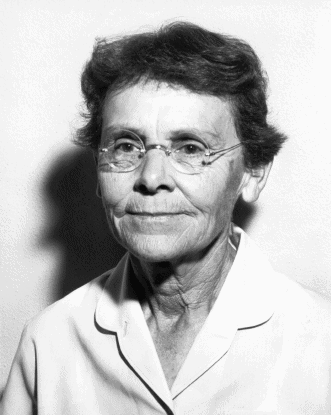
Barbara McClintock was
a geneticist whom received a Nobel Prize for discovering that genes could move
from place to place on a chromosome. McClintock’s father was a physician but at
a young age, she was forced to live with relatives in the country which in
return developed her deep love of nature. After graduating from high school,
she took a job rather than go on to college, because she lacked parental
support. However she studied privately and got accepted to Cornell University
as biology major. Being a Jew and a
woman, McClintock received a lot of rejections. In the 1940s she experimented,
alone without a researching team, with variations in the coloration of corn and
revealed that genetic information on the chromosomes are not stationary. She
also found out that genes that change their position on the chromosome may also
affect the behaviour of neighbouring genes which could be responsible for the
vast variations of the same species. In 1983 McClintock was awarded with a
Nobel Prize, she then died at the age of ninety in 1992.
"Barbara McClintock Biography |
BookRags.com." BookRags.com | Study Guides, Lesson Plans, Book Summaries and More. Web. 08 Feb. 2012. <http://www.bookrags.com/biography/barbara-mcclintock/>.
Rosalind Franklin (1920
– 1958)
Franklin
was born in a Jewish family in London and attended a girl’s school when she was
young. She then went to Newnham Collage in Cambridge to study physics and
chemistry. In 1942, she began to research at the British Coal Utilization
Research Association helping with the carbon fibre technology. In 1947,
Franklin worked on X-ray diffraction in Paris for the Central Government
Laboratory. In 1951, she moved back to London and worked for King’s college. She
started working on what she thought was her own DNA project, but when Maurice
Wilkins, laboratory’s second-in-command, came back from a vacation, Franklin
became Wilkins’ assistant rather than a colleague. They had an uneasy and
complicated relationship. There were also many rumours regarding Franklin’s
work, because of her gender. She then made an important discovery of the DNA
with x-ray; she was the first ever to take a photo of DNA. Together with
Wilkins, they published their x-ray diffraction pictures of DNA in Nature in April 1953, with Franklin’s
name as first author. However, because of the amount of time she spend working
with x-ray she was exposed to a lot of radiations and was later diagnosed with
ovarian cancer and died in 1958 at the age of 37. Unfortunately for Franklin,
there’s a rule against rewarding a dead person with the Nobel Prize, therefore
Wilkins was rewarded the Nobel Prize in 1962.
"Rosalind Franklin." Jewish Virtual
Library - Homepage. Web. 08 Feb.
2012.
<http://www.jewishvirtuallibrary.org/jsource/biography/franklin.html>.
Subscribe to:
Comments (Atom)